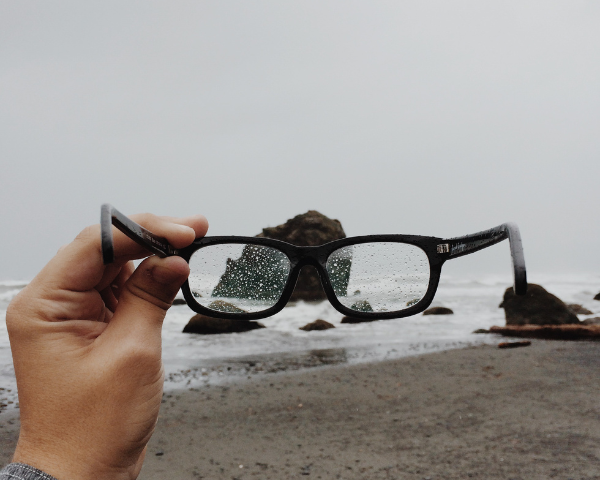








How Far Can the Human Eye See?
Reviewed by
Maria Horan FBDO
The eye is a complex and fascinating organ with many traits that go unrecognised. Distance vision is one of these. You may have heard the saying “as far as the eye can see” – but how far can the eye actually see?
Whether you’re gazing into the horizon from the peak of your favourite hiking spot, or paying attention to the road while commuting to work, you may have considered at what point our eyes stop seeing into the distance.
In this article we’ll explore the functions of vision and how these allow us to see at a distance.
How vision works
The process of seeing is a complex one. To determine how far the eye can see, we must first understand how the eye functions.
The eye connects to the brain via the optic nerve, sending signals to the visual cortex of the brain, which generates the images we see. Essentially, our eyes use light to create images in our brain, which inform our understanding of the outside world.
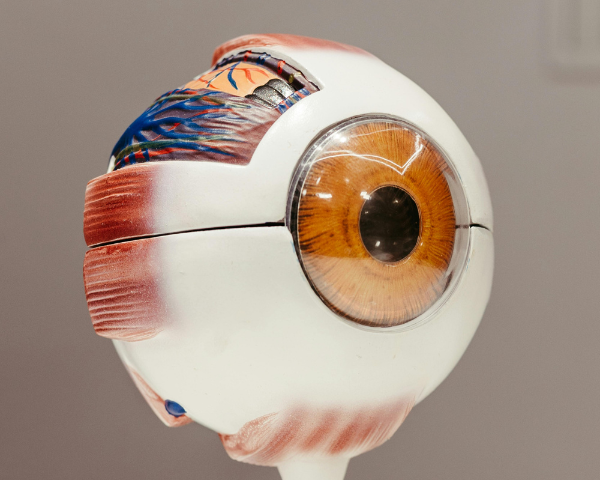
The lens works together with the cornea to focus light to the back of the eyeball where the retina is located.
Before light can reach the retina, it travels through the clear components of the internal eye, known as the cornea, the lens, the aqueous humour and the vitreous humour.
Once light reaches the retina, photoreceptors turn the light into signals, which are then transmitted via the optic nerve to the brain. Then, the brain turns the signals into the images we see.
There are other elements to vision, such as focus, which is determined by the level of precision of the light being transmitted to the retina. When it doesn’t reach the retina precisely, your vision may appear blurry.
Your eye’s muscles play a big role in this function, constantly making subtle changes to the shape of your eye, directing the focus point so that light lands correctly on the retina.
Although the process of seeing seems inherent to most, it is a very involved process, with several connective elements. Each of these steps requires perfect execution to achieve perfect vision and to see far distances.
How far can we actually see?
Determining how far the eye can actually see is a process with many variables.
The ability to see into the distance depends on the following factors.
Visual acuity
Visual acuity is how clearly you can see things from varying distances. Perfect visual acuity is commonly known as 20/20 vision. It means you can see at 20 feet what most people with “normal” vision should be able to see at that distance.
The curve of the Earth
The Earth’s roundness actually limits your view. If you’re standing at ground level with nothing in your way, the farthest you can see is to the horizon, which measures about 3 miles, or 4.8 kilometres, away.
Beyond that, the Earth gently curves out of our range of view.
The height of your vantage point
Height makes a big difference. The higher up you are, the further you’re able to see.
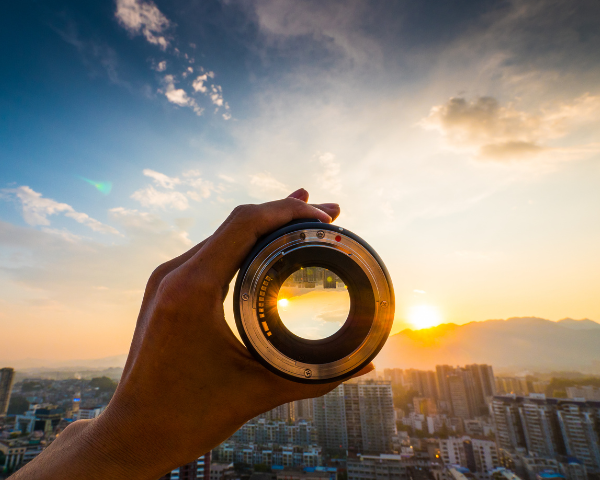
We know that from ground level we’re about 3-miles away. But think of your favourite hike, this could easily be up to 1,300 feet altitude. On a clear day, someone at the peak of a 1,300 feet mountain can see 40 to 50 miles out.
How big (and tall) the object is
Big, tall objects stand out—and can be seen from farther away, especially if they rise above the horizon. That’s why you can spot skyscrapers from more than 3 miles off, even from the ground, as long as the view’s clear and unobstructed.
Brightness
Because our vision is determined by light reaching our retina, bright objects are easier to see. The best (and most extreme) example is the sun. It’s 93 million miles away, yet it covers half of the planet. (Important reminder: never look directly at it!)
Things that obstruct your view
Most of the time, our view gets interrupted by buildings, trees, or even just the weather. Fog, dust, or air pollution can all act like filters, making the world look hazier and impacting how far we can see.
Even tiny particles in the air can change how clearly we see things in the distance.
Air temperature
Hot and cold air can bend light differently. Ever notice how heat rising from a road on a sunny day makes the air look like it’s rippling or shimmering? That’s known as atmospheric refraction.
Interestingly, on cooler days, especially when cool air coats the ground and warm air sits above it, light can bend in a way that extends how far we can see. So yes, temperature plays a part in how far your gaze can reach.
Essentially, how far you can see isn’t just about your eyes—it’s also about what you’re looking at, where you’re standing and the weather. All of these factors shape how we perceive the world around us.
DID YOU KNOW?
Eagles have the sharpest distance vision of any animal. Their eyesight is up to four times sharper than ours, letting them spot prey from astonishing distances with pinpoint focus.
How does distance vision work?
The eye’s lens changes shape to focus on objects at various distances by a process called accommodation, by adjusting the shape of the lens to bend light rays for different distances.
The muscles that surround the eye and change its shape are known as the ciliary muscles. The ciliary muscles play an important role in focusing our sight on distant objects as they control focus.
When looking at distant objects, the ciliary muscles relax, causing the lens to flatten so that light is focused correctly on the retina.
For objects that are closer, the muscles contract on the horizontal perimeters so that the lens becomes more curved at the centre.
To achieve clear and comfortable vision, the process of accommodation must be performed efficiently and the ciliary muscles must be flexible.
After light from a distance passes through the eye via the lens to reach the retina, photoreceptor cells are transmitted to the brain via the optic nerve. The signals from the photoreceptors are interpreted by the optic nerve and this informs how far we can see.
How can distance vision be impaired?
Distance vision, as mentioned, can be obstructed by objects in our field of view, either near or far. That said, there are also some vision conditions which can impair our ability to see at a distance.
Myopia
Myopia, or shortsightedness, is a refractive error where close objects are seen clearly, but distant objects appear blurry. This occurs when the eye is not able to focus light directly onto the retina, resulting in blurred distance vision.
Astigmatism
Distance vision may also be impacted by astigmatism, which is another refractive error caused by an irregularly shaped cornea.
When the cornea is not perfectly round, the light passing through the eye doesn’t focus evenly onto the retina at the back of the eye, causing blurred vision at all distances.
Glasses for distance vision correction
If your vision is affected by myopia or astigmatism, don’t worry. There are several options to correct these common refractive errors so that you can see clearly whether you’re reading, driving, or enjoying the sunset.
Distance vision lenses
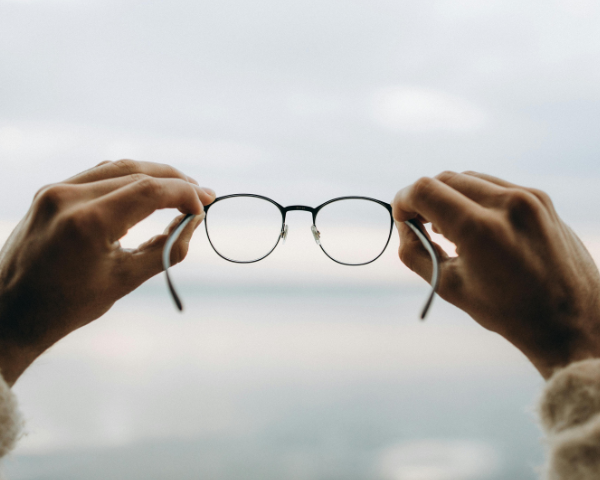
Single vision distance lenses are among the most popular types of prescription lenses. They’re commonly used to correct myopia, enabling near-sighted people to see clearly at a distance.
Single vision distance lenses can also assist those with astigmatism to help see at a distance of up to 30 feet.
Multifocal lenses
Multifocal lenses contain prescriptions for multiple distances. Each prescription caters to a different field of vision and multifocal lenses can be helpful for those with myopia, hyperopia, or other types of refractive errors.
They ensure you can easily see things at far, intermediate and near distances with a single pair of glasses.
The ‘distance’ portion of multifocal lenses is located in the top third of the lens, followed by intermediate in the centre and near-vision prescription in the lower third.
There’s no visible lines between the different prescriptions in multifocal lenses, so you have a smooth transition when switching between reading on a computer and looking into the horizon, for example.
Keep the horizon in sight
With the help of the right prescription and regular check ups with your dispensing optician, it’s possible to achieve clear distance vision even if you struggle with common refractive errors.
Amazingly, humans are able to see as far as the horizon, up to 3 miles into the distance, and even farther when standing on an elevated platform such as a tall building or mountain.
If you have any questions regarding distance vision, feel free to reach out to our optical dispensers. They’d be happy to help you find the perfect solution to correct your distance vision so you can sit back, relax and enjoy the view.
Related articles


Related articles